


A New FDA-Authorized Treatment Option for Early & Intermediate Dry Macular Degeneration


What Is Dry Age-Related Macular Degeneration (Dry AMD)?
Dry AMD is a common retinal condition that affects the macula — the part of the eye responsible for sharp central vision needed for reading, driving, recognizing faces, and detailed tasks.
As dry AMD progresses, patients may notice:
Blurred or distorted central vision
Difficulty reading
Reduced contrast sensitivity
Trouble seeing in dim lighting
Slower adjustment between light and dark environments
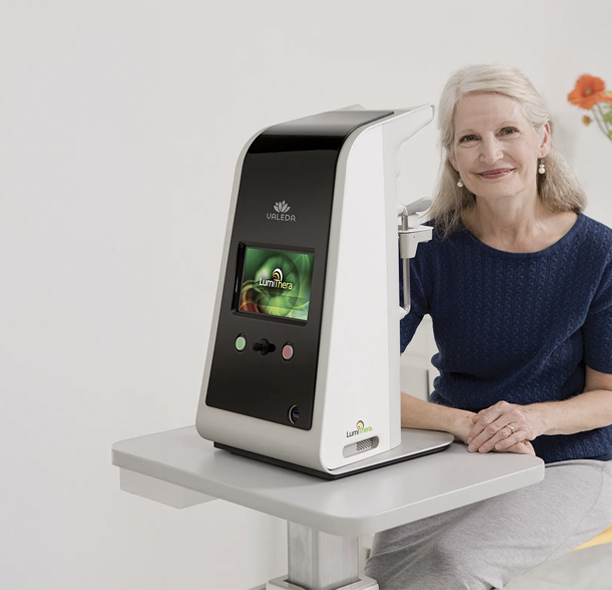
Introducing Valeda® Light Therapy
No injections. No surgery. Comfortable treatment lasting under five minutes per eye using therapeutic light.
What Is Valeda® Photobiomodulation Therapy?
Valeda® is an FDA-authorized, noninvasive light-based treatment designed for certain patients with early and intermediate dry AMD.
The treatment uses specific wavelengths of light to stimulate retinal cells and support healthier cellular function inside the retina.
This process is called Photobiomodulation (PBM)
Schedule an appointment
Dry vs Wet AMD
Both dry and wet macular degeneration affect the macula (the part of the eye that gives you sharp, straight-ahead vision). Dry type happens when the macula slowly thins and builds up tiny waste deposits over years, causing gradual blurring. Wet type happens when abnormal, weak blood vessels grow underneath and leak blood or fluid, causing fast, severe vision damage
Payment Options
Many insurances do not currently have an established coverage policy for this service (there is no National Coverage Determination or Local Coverage Determination established at this time). We offer flexible payment options to make this emerging technology available for you. As a self-pay service, you can choose to pay per visit, purchase a full treatment cycle at a discounted cash rate, or save even more with a yearly plan.
Graphic displaying (ideally interactive) the following pricing structures:
Pricing Structure
Single Cycle
9 visits
$140 per treatment
One-Year Program
27 treatments
$130 per treatment
Total: $3,510
Two-Year Program
54 treatments
$120 per treatment
Total: $6,480
Frequently Asked Questions
Does it hurt?
No.
Are there injections?
No.
How long?
Less than five minutes per eye.es or for flex-spend plans.
Can I drive afterward?
Usually yes.
Who is a candidate?
Your doctor will determine eligibility.
What is photobiomodulation (PBM)?
Photobiomodulation is a light-based therapy that uses specific wavelengths of visible and near-infrared light to stimulate cellular energy production within the mitochondria. By increasing ATP production and reducing oxidative stress, PBM helps support healthier retinal cells and may improve visual function in appropriately selected patients with Dry Age-Related Macular Degeneration.
Is Valeda treatment painful?
No. Valeda is completely non-invasive and painless. There are no injections, incisions, or medications involved. During treatment, patients simply look into the device while therapeutic light is delivered to the retina. Most patients find the treatment relaxing and comfortable.
Is this a laser treatment?
No. Valeda uses low-level light therapy, not retinal laser treatment.
Is this covered by insurance?
Coverage varies and may depend on your insurance plan and current reimbursement policies. Our team can help discuss financial considerations prior to treatment.
How often will I need treatment?
A typical treatment cycle consists of nine treatment sessions completed over approximately three to five weeks. Based on current clinical protocols, treatment is generally repeated every four months. Your doctor will recommend a schedule based on your retinal findings and visual goals.
Are there any side effects?
Valeda has demonstrated an excellent safety profile in clinical studies. The most common effect is a temporary afterimage (called photostress) that usually resolves within 15–30 seconds after treatment. No treatment-related serious adverse events were reported in the major clinical trials. Your doctor will review your medical history to determine whether Valeda is appropriate for you.
Can I resume normal activities after treatment?
Yes. Most patients are able to return to work, drive, read, and resume their normal daily activities immediately following treatment. No recovery period is required.
Who should not receive Valeda treatment?
Valeda may not be appropriate for individuals with certain photosensitivity disorders or those taking medications that increase sensitivity to specific wavelengths of light. A comprehensive retinal examination and review of your medical history will help determine whether you are a good candidate for treatment.
Will Valeda cure my macular degeneration?
No. There is currently no cure for Dry AMD. Valeda is designed to improve visual acuity and support healthier retinal function in appropriately selected patients. Early treatment may help preserve vision and slow functional decline, but individual results vary.
Am I a candidate for Valeda?
The best candidates are patients diagnosed with Dry Age-Related Macular Degeneration who meet the clinical criteria for treatment. During your consultation, your doctor will perform advanced retinal imaging and determine whether Valeda is the right option for your eyes.
Important Information
Valeda PBM therapy is not appropriate for every patient with AMD. Some retinal conditions may prevent candidacy.
Your doctor will review:
Retinal imaging
OCT scans
Visual function
Overall ocular health
before recommending treatment.
Questions?
Nappanee Family Eyecare 574-773-4341 nfe2020.com
We are happy to discuss whether Valeda PBM therapy may be appropriate for you.


Our Services
Visit Our Other Locations


© 2026 Appleseed Eyecare. All rights Reserved. Accessibility Statement - Privacy Policy - Sitemap
Powered by:
